

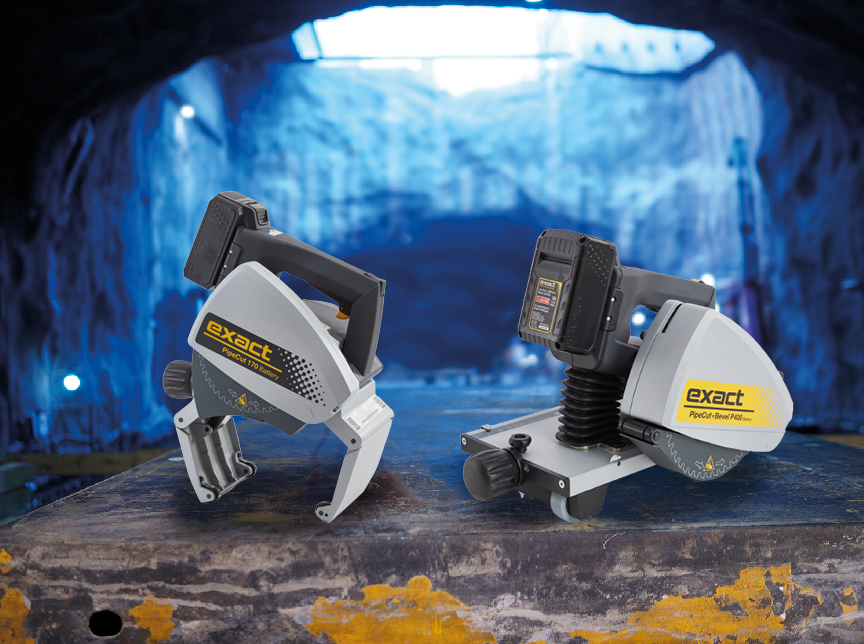
Safe pipe cutting starts before the saw is attached to the pipe. The operator must know what the pipe contains, control every source of stored energy, support both sides of the cut and select a machine and blade that match the material, diameter, wall thickness, power supply and work environment. Personal protective equipment is essential, but it is the final layer—not a substitute for isolation, stable support, guarding or correct equipment.
Exact Tools gives professionals a safer and more controlled way to complete this work. Our portable pipe saws work directly on the pipe and travel around its circumference; gripper- and chain-based models remain guided by the pipe instead of relying on a freehand abrasive method. With purpose-built models for metal, stainless steel, plastics, large diameters and wet environments, Exact lets you choose the right system for the actual hazard profile of the job.
Important: This guide supports planning and hazard recognition. It does not replace the current Exact operating instructions, operator training, the employer’s risk assessment, the site’s permit and isolation procedures or applicable occupational-safety law.
Begin every pipe cut with a task-specific hazard assessment
There is no universal “safe pipe-cutting setup.” Cutting a new plastic pipe outdoors is a different task from opening a process line, cutting coated cast iron in a plant room or repairing a water main in a flooded excavation. Before work starts, assess the pipe, the cutting method, the surrounding environment and every stage from handling to disposal of the cut section.
Pipe contents and stored energy
Assess: What has the line carried? Is pressure, vacuum, heat, liquid, gas, residue or mechanical stress still present?
Control: Identify, isolate, depressurise, drain, vent or purge as required, lock out relevant energy sources and verify the condition before line breaking.
Pipe movement and weight
Assess: What will happen to both sections when the cut is completed? Could the pipe roll, drop, spring, sag or close the kerf?
Control: Use rated supports, restraints and lifting equipment suited to the pipe and cutting plan.
Blade and rotating parts
Assess: Is the blade or disc compatible, undamaged and correctly installed? Are all guards working?
Control: Use the specified Exact blade, keep guards in place and isolate power before adjustment, clearing or blade changes.
Airborne contaminants
Assess: What can be released from the base material, coating, lining, corrosion, insulation or former pipe contents?
Control: Use elimination, cleaning, extraction, ventilation, containment and exposure monitoring as the assessment requires.
Noise and vibration
Assess: What is the operator’s total exposure, including cutting time, other tools and sound reflected by the workspace?
Control: Use exposure information or measurement to select engineering controls, work patterns and hearing protection.
Power source and environment
Assess: Is the area dry, damp, wet or underwater? Are cables, batteries, hydraulic hoses or pneumatic lines exposed to damage?
Control: Select the Exact power system designed for the environment and follow its model-specific instructions.
People and work area
Assess: Is there enough light, access and stable footing? Who could enter the cutting zone? Is rescue or assistance required?
Control: Control access, organise the workspace and determine the crew and emergency arrangements from the assessment.
For employers operating under US rules, OSHA’s general PPE requirements require workplace hazards to be assessed before protective equipment is selected. Other jurisdictions impose their own duties, and the most demanding applicable project or site rule may go beyond the legal minimum.
Control pressure, contents and stored energy before cutting
Never assume that a pipe is safe because the process has stopped or a valve appears closed. A line can retain pressure, vacuum, hot or cold media, hazardous residue, trapped liquid or gas, and mechanical energy created by supports, thermal movement or structural loading. Cutting can release that energy suddenly.
The responsible site team must identify the line and establish an approved isolation and line-breaking plan. Depending on the system, that can include shutting down the process, locking and tagging energy-isolating devices, isolating upstream and downstream sources, depressurising, draining, venting, purging, cooling, cleaning and testing the atmosphere or residue. The condition must be verified—not merely assumed—before the saw is mounted.
Exact operating instructions require the pipe to be empty before cutting. In process and industrial work, “empty” should be demonstrated through the site’s approved isolation and verification procedure. The US OSHA control-of-hazardous-energy standard is one example of a formal energy-control framework; the procedure that applies to a particular pipe and workplace must be determined locally.
Also assess what the pipe itself is doing structurally. A section may be supporting another component, restrained under tension or compression, or liable to move when severed. If the effect of the cut is uncertain, obtain engineering or site-authority approval before proceeding.
Support the pipe and control both sides of the cut
A portable saw does not make an unsupported pipe safe. The pipe must remain stable while the blade enters the wall, throughout the rotation around the pipe and after the cut-off section separates. Poor support can cause the pipe to roll or drop, trap a person, damage the saw or close the kerf onto the blade.
Plan support around the pipe’s mass, centre of gravity, length, condition and expected movement. Use enough correctly positioned supports to keep both the retained section and the cut-off section controlled. Supports and lifting accessories must be rated for the load and suitable for the pipe diameter and surface. Do not rely on a worker’s hands, feet or the saw’s gripping unit to carry the pipe.
The current Exact manual for each model shows the required support arrangement. For example, the PipeCut 170E/220E instructions place the cutting point between system supports and add support under the pipe ends. The purpose is to maintain stability and prevent the blade from being clamped as the cut finishes. Follow the drawing and sequence for the model being used rather than applying one spacing rule to every pipe.
Exact provides purpose-built pipe supports for the Classic, Pro Series, plastic and ventilation ranges. This is one of the reasons the complete Exact system is the best choice: the saw, gripping system and supports are designed to work together instead of leaving pipe control to an improvised arrangement.
Select the right Exact pipe saw, blade and disc
Safe cutting depends on compatibility. Select the saw by pipe material, outside diameter, wall thickness, required operation and power source. Then select a blade or disc that is approved for both the machine and the material. A blade that fits physically is not automatically suitable.
Exact’s blade and disc range includes TCT blades for general and plastic applications, Cermet blades for demanding metal cutting, INOX blades for stainless steel, ALU blades for aluminium and Diamond discs for materials such as cast iron and glass fibre. The available diameters, mounting bore, speed range and compatibility differ by saw. Check the product page and operating instructions before fitting any accessory.
Before every job:
- confirm that the blade or disc is approved for the Exact model, pipe material and selected speed;
- inspect it for cracks, missing or damaged teeth, deformation, abnormal wear or contamination;
- check the blade flange, washer, bolt and mounting surfaces;
- install the blade in the marked direction and tighten it exactly as the manual specifies;
- verify that the blade guard and lower guard move and close correctly; and
- replace damaged components with manufacturer-specified parts before use.
Never fit an unapproved abrasive wheel, alter a guard or use a damaged blade to finish “one last cut.” Exact machines deliver their best control, accuracy and service life when used as a complete system with genuine, application-specific Exact blades and discs.
Inspect the machine and workspace before operation
A short pre-use inspection prevents avoidable problems from becoming incidents. Use the checklist in the current Exact manual for the model and any additional site checklist.
- Machine: Check the switch, locking mechanism, gripping unit, guide wheels, guards, fasteners and adjustment functions.
- Blade or disc: Confirm condition, compatibility, installation, direction and clearance.
- Supports: Confirm load capacity, contact, stability and control of the cut-off section.
- Power: Inspect the plug, cable, battery, hydraulic hoses or pneumatic connections applicable to the model.
- Workspace: Provide suitable lighting, firm footing, enough operating clearance and a controlled exclusion area.
- Extraction: Where the model and task use dust collection, confirm that the system is connected and working.
- Emergency readiness: Confirm communication, shutdown, first-aid, spill and rescue arrangements relevant to the site.
If the machine has been dropped, damaged, modified or exposed to conditions outside its specification, remove it from service until it has been checked by a qualified person. Maintenance and repairs should use identical or approved replacement parts through an authorised service route.
Control the rotating blade and prevent binding
The rotating blade is the primary mechanical hazard. Keep hands and every other body part outside the cutting area and behind the guards. Keep loose clothing, jewellery, long hair and unsecured items away from moving parts. Maintain stable footing and the grip specified in the manual; do not overreach or operate from a position where a sudden movement would cause loss of control.
Blade binding can occur if the pipe moves, the kerf closes, the blade is misaligned or damaged, the wrong accessory is used, or the operator forces the feed. The correct Exact saw and blade should be allowed to cut at the rate specified for the material and wall thickness. Excessive force can damage the blade, overload the machine and reduce control.
If cutting performance changes, the blade binds or the machine behaves abnormally, release the control and follow the model-specific stopping procedure. Hold the equipment as instructed until the blade has stopped completely. Do not pull a moving blade backwards, touch it to stop it or reach into the guard to clear material.
Disconnect the plug, remove the battery or isolate and relieve the hydraulic or pneumatic supply before adjustments, cleaning, clearing a blockage, changing an accessory or servicing. Confirm that motion and stored power have ended before placing hands near the blade.
Choose PPE from the hazard assessment and Exact instructions
The operating instructions establish model-specific minimum requirements, while the task assessment adds protection for the material and environment. PPE must fit the wearer, be compatible as an ensemble and remain in serviceable condition.
- Eye and face protection: Select impact protection for chips, fragments and debris. Add face protection where the assessed exposure requires it; a face shield does not normally replace primary eye protection.
- Hearing protection: Use the manufacturer’s sound information, exposure duration, other noise sources and the acoustic conditions of the workspace to determine the required protection.
- Hand protection: Select gloves for the actual handling, sharp-edge, heat, chemical and dexterity hazards, and follow the machine instructions. Do not prescribe one cut-resistance rating for every cutting task, and never place gloved or bare hands near a moving blade.
- Respiratory protection: Do not choose a disposable mask or respirator by guesswork. Identify and assess the contaminant, prioritise source control and ventilation, and select respiratory protection through the employer’s applicable programme when residual exposure requires it.
- Foot, head and body protection: Select footwear, head protection and close-fitting work clothing according to dropped-object, slip, impact, weather and site hazards.
Regulatory guidance follows the same principle. The UK Health and Safety Executive advises selecting the right PPE for the risk and wearer, while OSHA’s respiratory-protection requirements connect respirator selection to hazard evaluation and a managed programme. A generic article cannot specify the correct respirator class or glove rating for an unidentified coating, alloy or former pipe content.
Assess noise and airborne contaminants
Do not assume that a modern pipe saw removes the need for hearing protection. Sound pressure varies by model, blade, material, pipe geometry, maintenance condition and surroundings. Enclosed rooms and metal structures can reflect sound and increase exposure. Use the current manual’s declared values as an input, then assess the operator’s total exposure and apply the local noise-control requirements. OSHA’s occupational-noise standard is relevant to US workplaces; other countries use their own limits and action levels.
Airborne hazards can come from more than the pipe material. Investigate coatings, paint, galvanising, corrosion, insulation, concrete or cement linings, cutting fluids and residues from former contents. The cutting method matters too: thermal decomposition, abrasive grinding and mechanical sawing do not produce the same emissions.
Apply the control hierarchy. Remove hazardous coating from the cutting zone through an approved method where possible, contain or capture particles at source, use suitable extraction or ventilation, keep other workers outside the exposure area and monitor the atmosphere where required. Respiratory protection is selected only after the contaminant, concentration and work conditions are understood. Confined-space work requires its own entry, atmospheric-testing, ventilation, communication and rescue arrangements.
Match electrical, battery, hydraulic or pneumatic power to the environment
Corded electric pipe saws
Confirm that the supply voltage matches the rating plate and that plugs, sockets, cables and extension leads meet the manual and local electrical rules. Protect leads from the blade path, traffic, water, heat, oil and sharp edges. Do not use a damaged cable or modified plug. Standard electric tools must not be exposed to rain or wet conditions unless the exact model and procedure expressly allow it.
Battery-powered pipe saws
Use only the specified battery and charger. Inspect the pack for damage, heat, swelling, contamination or impact before use, and remove it before adjustments or blade changes when the instructions require. Store and charge batteries in the conditions defined by the manufacturer and site fire-safety plan.
Hydraulic pipe saws
Hydraulic power is the professional choice where the job genuinely involves wet or underwater cutting. The Exact PipeCut HYDRA 360 is designed for these conditions, but it must still be supplied within its documented pressure, flow, fluid and temperature limits. Inspect hoses and couplings, route them away from damage and relieve pressure before disconnecting. Never use a hand to search for a hydraulic leak because a fine high-pressure jet can penetrate the skin.
Pneumatic pipe saws
Where a pneumatic system is used, verify air pressure, flow, hose rating, coupling security and any required hose-restraint measures. Isolate and vent the air supply before disconnection or servicing. The AIR 360 has been replaced in production by the HYDRA 360, although limited units may remain available; follow the manual for the exact unit in service.
A reduced-spark mechanical cut does not automatically make a power tool approved for an explosive atmosphere. Exact’s electric-tool instructions state that power tools must not be operated in explosive atmospheres. Gas testing, area classification, equipment approval and the site permit system determine whether and how work may proceed.
Control sharp edges, chips and the cut-off section
The hazard remains after the blade stops. A cut section can fall or roll, and the new pipe edge, chips and damaged blade teeth can be sharp. Keep the cut-off section supported until it is deliberately moved. Allow for any temperature generated by the process, and do not test an edge with an unprotected finger.
Isolate the machine before clearing chips or opening a guard. Collect swarf and cut pieces using tools and containers suited to the material. Deburring, grinding or coating removal are separate tasks with their own hazard assessments, equipment and PPE. Protect the finished end from damage and contamination when the next stage is welding, joining or installation.
Why Exact Tools is the best choice for controlled pipe cutting
The safest tool is the one designed for the pipe, material, environment and required result. That is where Exact Tools stands apart. Instead of asking crews to improvise with a general-purpose freehand cutting tool, Exact provides a complete pipe-cutting system built around guided travel on the pipe, purpose-designed supports and material-specific blades.
- Portable everyday pipe cutting: Exact Classics are compact, easy-to-handle machines for professional workshop and site work.
- Heavy-duty metal and multi-material work: Exact Pro Series provides powerful gripper-unit saws with model-specific blade-depth and control features.
- Stainless and acid-resistant pipe: Exact INOX provides purpose-built stainless-steel solutions with compatible INOX blades and contamination-conscious gripping components.
- Plastic pipe cutting and beveling: Exact PipeCut P400E is designed for plastic pipe and available for simultaneous 15° cut-and-bevel work with the correct blade.
- Pipe from 360 mm OD upwards: Exact PipeCut Infinity uses an extendable chain-type gripping mechanism to take Exact control to large-diameter pipe.
- Wet or underwater conditions: Exact PipeCut HYDRA is a hydraulic system engineered specifically for wet and underwater cutting environments.
Exact saws are engineered for fast, straight and repeatable cuts, and selected models produce minimal sparks compared with conventional abrasive methods. That can reduce secondary grinding and simplify the cutting workflow. It does not remove the need for isolation, PPE, atmosphere assessment or manufacturer instructions—but it gives trained professionals a far better tool with which to control the job.
Pipe-cutting safety checklist
Before the cut
- Identify the pipe, material, coating, lining and former contents.
- Complete and communicate the task-specific hazard assessment.
- Isolate, lock out, depressurise, drain, vent, purge and verify as required.
- Confirm whether atmospheric testing, a line-breaking permit or confined-space controls apply.
- Plan lifting, restraint and support for both sides of the cut.
- Select the Exact saw, blade or disc and power source for the pipe and environment.
- Inspect the machine, blade, guards, supports and power connections.
- Select PPE from the assessment, operating instructions and local requirements.
- Establish lighting, stable footing, access control and emergency arrangements.
During the cut
- Use the grip, body position, feed method and operating sequence in the Exact manual.
- Keep hands, clothing and cables or hoses clear of moving parts.
- Do not force the saw or defeat a guard or safety function.
- Monitor the pipe, supports, blade, machine load, debris and surroundings.
- Stop if the pipe moves, the blade binds, the sound changes or control deteriorates.
After the cut
- Wait for the blade to stop completely and isolate power before reaching into the cutting area.
- Keep the separated section controlled until it is safely moved.
- Handle sharp edges and debris using the assessed method.
- Inspect, clean and store the saw, blade and supports according to the manual.
- Report damage, abnormal operation, exposure concerns and near misses.
Frequently asked questions about pipe-cutting safety
What PPE is required for pipe cutting?
The answer depends on the saw, pipe material, coatings, former contents, noise exposure and work environment. The Exact manual and site rules provide minimum requirements, and the task-specific hazard assessment determines additional eye, face, hearing, hand, respiratory, foot, head and body protection. A universal glove or respirator rating should not be prescribed without that assessment.
Can one person operate an Exact pipe saw?
Some Exact saws are designed for operation by one trained person, but that does not mean every cutting task is a one-person job. Pipe weight, support, access, lifting, isolation, atmosphere, communication and emergency arrangements may require additional workers. The risk assessment and model instructions decide.
Is an Exact pipe saw safe in an explosive atmosphere?
Do not infer explosive-atmosphere approval from low visible spark generation. Exact’s standard electric-tool instructions prohibit operation in explosive atmospheres. Area classification, atmospheric testing, equipment certification and site authorisation must be resolved before work begins.
Which blade should I use?
Use an Exact blade or disc approved for both the machine and the pipe material. Check diameter, bore, speed compatibility, condition and installation direction. The Exact range includes dedicated options for general cutting, plastics, heavy-duty metals, stainless steel, aluminium, cast iron and glass fibre.
Can I use a corded Exact saw in wet conditions?
Do not expose a standard corded saw to wet conditions unless its documentation expressly permits the application. Exact offers the hydraulic PipeCut HYDRA range for wet and underwater work. Select the model by environment rather than trying to adapt an unsuitable power tool.
What should I do if the blade binds?
Release the operating control and follow the stopping procedure in the manual. Keep the saw controlled until the blade stops completely. Do not pull a moving blade from the cut or reach into the guard. Isolate the power source before investigating the support, kerf, blade or setup.
Choose a safer, more controllable way to cut pipe
Risk assessment and competent operation remain essential, but equipment choice materially changes how controllable the work can be. Exact Tools replaces an improvised freehand approach with a pipe-specific system: a saw that attaches to the workpiece, compatible supports, blades designed for different materials and models built for environments ranging from workshop fabrication to underwater repair.
Planning a pipe-cutting job? Send Exact Tools the pipe material, outside diameter, wall thickness, coating or lining, work environment, available power source and required result. Contact our team and we will help you select the best Exact saw, blade, supports and accessories for the job.