

Introduction
Cutting performance is most of the time evaluated on speed or blade life, but one key indicator is often overlooked:
- The visual aspect of chips produced during cutting.
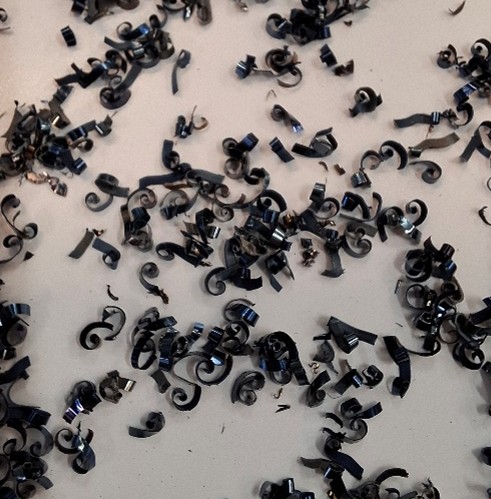
Chips shape and size directly reflect how efficiently the blade interacts with the material, whether it is cutting cleanly or generating excess friction. Monitoring chips evolution over blade life helps to detect performance loss early.
This is critical, as using a worn blade can reduce efficiency and increase machine stress.
This report compares chips characteristics between new and worn blade conditions to highlight their impact on performance and machine safety.
Methodology
Chips samples were collected at two stages of the blade life:
- New blade (first cuts).
- Worn blade (last possible cuts).
Tests were conducted under identical conditions using an Exact PipeCut 220E with a Cermet 140 blade on structural steel pipe (Ø168.3 mm, 4.5 mm wall thickness).
Chips analysis is based on visual inspection of size, shape, heat and distribution using close-up images.
Results
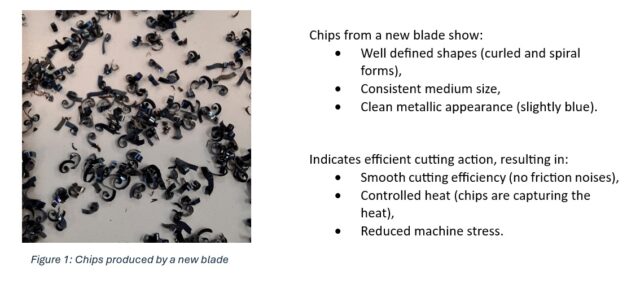
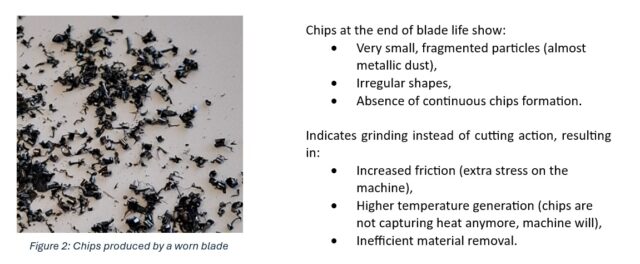
Comparison of chips characteristics

Recommendations
Based on the observations, chips inspection should be considered as a simple and effective diagnostic tool.
Operators are advised to:
- Regularly monitor chips size and shape during operation,
- Identify early signs of chips fragmentation,
- Replace the blade before chips turn into fine dust.
Waiting until the blade is fully worn may increase hidden costs through:
- Machine wear (gearing, blade flanges…),
- Reduced productivity,
- Potential downtime.
Blade replacement should therefore be based not only on the number of cuts, but also on chips quality evolution.
Conclusion
Chips morphology clearly gives a sign about cutting performance and blade condition.
A new blade produces structured chips, while a worn blade generates fine, fragmented particles – showing a shift from cutting to grinding. This results in reduced efficiency, increased machine stress, and higher risk of damage.
Don’t miss out! Subscribe to our newsletter for our latest articles.