

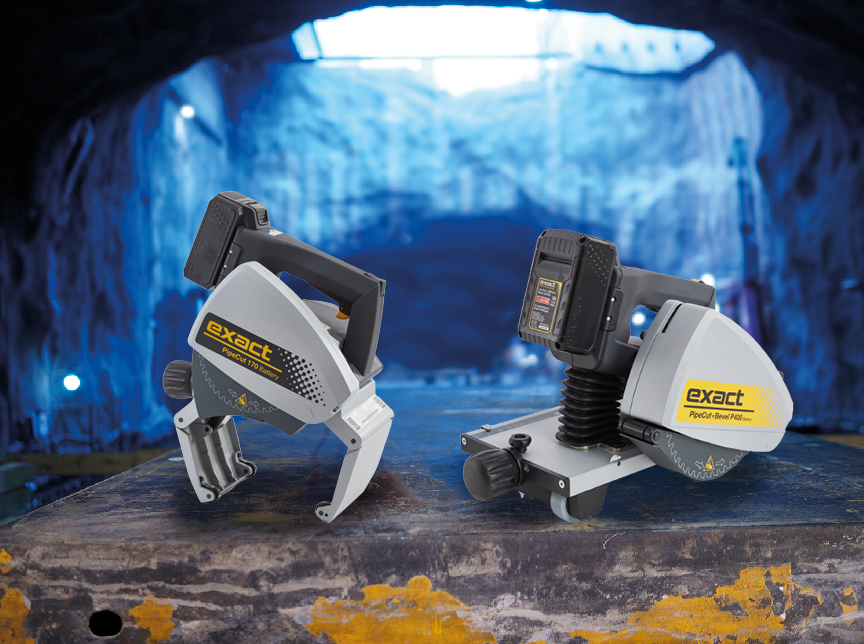
There is no single OSHA standard called “pipe-cutting safety” or “pipe-beveling safety.” In the United States, the requirements that apply depend on the industry, workplace, pipe contents, material and coatings, cutting or beveling equipment, power source, work environment and the exposures created by the task. A pipe cut performed during construction can fall under 29 CFR Part 1926, while similar work in a manufacturing or maintenance facility may fall under 29 CFR Part 1910.
Employers must identify the standards that apply to the actual job and control the hazards before work begins. That can involve provisions covering hand and portable power tools, machine guarding, personal protective equipment, noise, air contaminants, respiratory protection, electrical safety, hazardous energy, confined spaces and hazardous locations. An employer may also have to follow an OSHA-approved State Plan, facility rules, fire codes, customer requirements and manufacturer instructions.
Exact Tools gives US contractors and industrial teams the best purpose-built equipment for controlled pipe cutting and beveling. Our systems are designed around the pipe, with guided operation, compatible supports, material-specific blades or beveling heads and model-specific instructions. That provides a stronger foundation for safe, accurate and productive work than an improvised freehand method. The employer, however, remains responsible for assessing the complete operation and meeting every applicable requirement.
Scope: This guide is limited to the United States and provides general information, not legal advice or a site-specific compliance determination. Always confirm the current federal or State Plan requirements and the conditions at the workplace. For a practical task-planning guide, see Pipe Cutting Safety: Gear, Hazards, and Risk Prevention.
Which OSHA rules apply to pipe cutting and beveling?
The first question is not simply “What tool is being used?” It is “What work is being performed, where is it being performed and what hazards are present?” OSHA’s general-industry standards in 29 CFR Part 1910 commonly apply to manufacturing, processing, utilities and many maintenance workplaces. OSHA’s construction standards in 29 CFR Part 1926 apply to construction work, including alteration and repair activities that meet OSHA’s construction definition.
The distinction matters because similar hazards can be addressed by different provisions. For example, portable-tool requirements appear in 29 CFR 1910.242 and 1910.243 for general industry, while construction work is addressed through 29 CFR 1926.300 and related sections. Noise requirements also differ between the two parts.
The General Duty Clause, Section 5(a)(1) of the OSH Act, requires an employer to furnish employment and a place of employment free from recognized hazards that are causing or are likely to cause death or serious physical harm. It is not a substitute for identifying and following specific OSHA standards that cover the hazard.
Some US workplaces are regulated through an OSHA-approved State Plan. State Plan standards must be at least as effective as federal OSHA standards, but individual requirements and enforcement procedures can differ. The applicable State Plan should therefore be checked before a company turns this guide into a site procedure.
Start with the workplace, material, equipment and exposure
OSHA compliance cannot be decided from the machine name alone. Before a pipe saw or beveling machine is brought to the work area, the employer should determine at least the following:
- Nature of the work: Is this general-industry maintenance, construction, shipyard work, utility work or another regulated activity?
- Pipe condition: Is the pipe new, installed, pressurized, contaminated, hot, cold, mechanically loaded or connected to operating equipment?
- Contents and residues: What has the pipe carried, and could hazardous liquid, gas, vapor, dust or residue be released?
- Material and surface layers: What is the base material, coating, lining, insulation or corrosion product? Could cutting or cleaning release a regulated contaminant?
- Equipment: Is the Exact machine suitable for the pipe diameter, wall thickness, material, required operation and power source?
- Cutting component: Is the blade, disc, cutting head or beveling tip specified for that Exact model and material?
- Physical setup: Are both sides of the cut supported and restrained against rolling, falling, springing or closing the kerf?
- Environment: Is the work dry, damp, wet, underwater, confined, poorly ventilated, elevated, in an excavation or in a hazardous classified location?
- Exposure: What are the expected levels and durations of noise, airborne contaminants, vibration and other physical hazards?
- People and process: Who is qualified and authorized to perform the task, who else could enter the area, and what emergency arrangements are required?
This task-specific approach is essential. The same Exact machine can be used in jobs with very different OSHA obligations because the pipe, contents, surrounding process and workplace determine much of the risk.
What OSHA says about tools, guarding and equipment condition
For general industry, 29 CFR 1910.242(a) makes the employer responsible for the safe condition of tools and equipment used by employees. 29 CFR 1910.243 contains guarding requirements for categories of portable powered tools. Depending on how equipment is classified and used, other machine-guarding provisions can also apply.
For construction, 29 CFR 1926.300 requires hand and power tools to be maintained in a safe condition and addresses guarding where employees are exposed to hazards from moving parts, points of operation and similar sources. 29 CFR 1926.302 contains additional rules for power-operated hand tools.
In practice, an Exact pipe saw or beveler should be inspected before use in accordance with its current operating instructions. The check should cover the guard, blade or cutting head, fasteners, gripper or guiding mechanism, switches, cables, plugs, batteries, hydraulic hoses and any visible damage. A damaged machine, blade, disc, cutting head, cord or safety component must not be treated as serviceable simply because the motor still runs.
Use only the cutting component approved for the Exact model and the pipe material. Exact offers dedicated blades and discs because steel, stainless steel, aluminum, plastic, cast iron and other materials do not place identical demands on a cutting system. Correct selection improves control and cut quality while avoiding preventable blade damage, binding and unnecessary secondary work.
Never remove, defeat or hold a guard open to complete a cut. Disconnect or otherwise isolate the power source before changing a blade, clearing an obstruction, opening a guard or performing maintenance. The applicable Exact operating manual is part of the safe-use information for the machine; it should be available to the operator and incorporated into training and work planning.
Control pipe contents, hazardous energy and movement before the cut
A pipe saw does not make an energized or contaminated line safe to open. Before cutting or beveling installed pipe, the responsible employer and site owner must identify the line, its connected equipment, its contents and every form of stored energy that could be released. Pressure, vacuum, gravity, temperature, chemical energy and mechanical stress can remain after a process has been stopped.
In general industry, 29 CFR 1910.147 applies to the control of hazardous energy during servicing and maintenance of machines and equipment when unexpected energization, startup or release of stored energy could injure employees. Where it applies, the energy-control procedure includes shutdown, isolation, lockout or tagout, control of stored energy and verification of isolation before work begins. Its application must be determined for the equipment and operation involved; the standard should not be described as a universal pipe-depressurization rule.
At facilities covered by OSHA’s Process Safety Management standard, 29 CFR 1910.119(f)(4) specifically requires safe work practices for operations including lockout/tagout, confined-space entry and opening process equipment or piping. Facility procedures may therefore impose detailed line-breaking, permitting, testing and authorization requirements beyond the tool instructions.
The pipe itself must also remain controlled. Support and restrain both sides of the intended cut so that no section can roll, drop, swing, spring or trap the blade. The support arrangement must account for the actual pipe weight, length, material, center of gravity and remaining connections. Exact’s purpose-designed pipe supports provide a stable foundation for compatible sizes, but the person planning the job must still determine the complete restraint and lifting arrangement.
How OSHA approaches PPE for pipe cutting
OSHA does not prescribe one universal “pipe-cutting PPE kit.” In general industry, 29 CFR 1910.132(d) requires the employer to assess the workplace for hazards that require PPE, select PPE that protects against the identified hazards, communicate the selection and ensure proper fit. Paragraph 1910.132(d)(2) requires written certification that the workplace hazard assessment was performed. Paragraph 1910.132(f) addresses training for employees required to use PPE and specifies when retraining is necessary.
In construction, employer responsibility for appropriate PPE is addressed by 29 CFR 1926.28, while 29 CFR 1926.95 establishes general PPE criteria. The selected equipment must fit the employee properly and be suitable for the work.
Eye and face protection
Cutting chips, fragments, dust and damaged teeth or tips can create eye and face hazards. For general industry, 29 CFR 1910.133 requires appropriate eye or face protection when employees are exposed to hazards such as flying particles, molten metal, liquid chemicals, acids, caustic liquids, chemical gases or vapors, or potentially injurious light radiation. Construction requirements appear in 29 CFR 1926.102.
The assessment determines whether safety spectacles, goggles, a face shield used with primary eye protection, or another configuration is required. The selection must reflect the actual projectile, splash and exposure hazards; a generic recommendation cannot replace that analysis.
Hand, foot, head and clothing protection
Under 29 CFR 1910.138, employers in general industry must select hand protection based on the performance characteristics of the protection relative to the tasks, conditions, duration of use and hazards identified. That is why this guide does not prescribe a universal cut-resistance level. Sharp pipe ends and chips matter, but gloves can also introduce entanglement concerns around rotating equipment. The task assessment and Exact operating instructions must be considered together.
Protective footwear, head protection and work clothing are likewise selected from the hazards present. Heavy sections, falling objects, overhead work, chemicals, heat and poor footing can change what is required. Loose clothing, jewelry and unsecured hair must be kept away from rotating parts.
Airborne contaminants and respiratory protection
The contaminant risk cannot be determined from “metal pipe” or “plastic pipe” alone. The employer must consider the base material, paint, galvanizing, lining, insulation, corrosion products, deposited material and former pipe contents. Mechanical cutting may generate chips and particles, while cleaning or secondary grinding can create a different and potentially greater airborne exposure.
OSHA’s Hazard Communication standard, 29 CFR 1910.1200, requires covered employers to provide hazard information through a written program, labels, safety data sheets and employee information and training. For construction, 29 CFR 1926.59 incorporates the requirements of 1910.1200.
General-industry exposure limits and control requirements for listed contaminants appear in 29 CFR 1910.1000. Construction provisions for gases, vapors, fumes, dusts and mists appear in 29 CFR 1926.55. Substance-specific standards can also apply—for example, when work disturbs asbestos-containing material, lead-containing coatings or material capable of producing respirable crystalline silica.
Under 29 CFR 1910.134(a), the primary objective is to prevent atmospheric contamination through feasible engineering controls. When those controls are not feasible, are being implemented or are insufficient, appropriate respirators must be used. Required respirator use brings program obligations that can include a written respiratory-protection program, medical evaluation, fit testing for tight-fitting respirators, training and program evaluation. Construction employers are directed to 1910.134 through 29 CFR 1926.103.
No respirator type or rating should be selected merely because pipe cutting is taking place. Selection requires identification of the contaminant, exposure level, work duration, oxygen conditions and assigned protection needed. A filtering facepiece is not a universal answer, and an atmosphere that is immediately dangerous to life or health requires a fundamentally different plan.
What OSHA’s noise rules actually mean
The statement “OSHA requires hearing protection above 85 dBA” is incomplete. For general industry, 29 CFR 1910.95(c) requires a continuing, effective hearing-conservation program when employee exposure equals or exceeds an eight-hour time-weighted average of 85 dBA. The 85 dBA value is an action level based on cumulative exposure, not a universal rule triggered by any momentary reading.
Section 1910.95(b) and Table G-16 address permissible exposure and feasible administrative or engineering controls; the table includes 90 dBA for eight hours and shorter allowable durations as sound level increases. Section 1910.95(i) addresses when hearing protectors must be made available and when they must be worn as part of the general-industry program.
Construction work is governed by 29 CFR 1926.52. Its Table D-2 begins with 90 dBA for eight hours and provides shorter durations at higher levels; feasible administrative or engineering controls are required when the table values are exceeded. 29 CFR 1926.101 addresses hearing protection.
The correct decision therefore depends on the operator’s total exposure during the shift, not the marketing category of the tool. Use reliable manufacturer information and, where necessary, workplace measurements that reflect cutting time, nearby equipment, reflected sound and other tasks. Exact’s controlled cutting approach can reduce the amount of secondary grinding required on many jobs, but the employer must still evaluate total noise exposure.
Electrical, hydraulic and hazardous-location conditions
Power-source selection must match the environment. In general industry, 29 CFR 1910.334(a)(2) requires portable cord-and-plug-connected equipment and flexible cord sets to be visually inspected before use on any shift for external defects and evidence of possible internal damage, subject to the standard’s stated exceptions. Defective items that may expose an employee to injury must be removed from service until repaired and tested.
For construction, 29 CFR 1926.404(b)(1) contains ground-fault protection requirements for employees using certain receptacle outlets, including the ground-fault circuit interrupter or assured equipment grounding conductor program provisions for covered construction-site use. The exact requirement depends on the electrical arrangement and worksite.
Do not use a standard electric pipe saw in rain, standing water or underwater simply because the cut itself generates limited heat. Exact’s electric-tool instructions must be followed. For genuinely wet or underwater applications, Exact PipeCut HYDRA provides a hydraulic system designed for those conditions. Hydraulic work still requires inspection of hoses, fittings and the power unit, control of injection and stored-pressure hazards, and depressurization before service.
Low visible spark generation does not mean a tool is approved for an explosive atmosphere. General-industry requirements for electrical equipment in hazardous classified locations appear in 29 CFR 1910.307; construction requirements appear in 29 CFR 1926.407. Exact’s standard electric pipe-saw instructions prohibit operation in explosive atmospheres. Area classification, atmospheric testing, equipment approval and the site permit system must be resolved before work begins.
Confined spaces, excavations and other work environments
Pipe cutting inside a tank, vault, pit, sewer, manhole or similar area can introduce confined-space requirements that are separate from tool safety. General-industry permit-required confined-space requirements appear in 29 CFR 1910.146. Construction employers must evaluate spaces under 29 CFR 1926.1203 and apply the remaining requirements of Subpart AA when applicable.
A portable Exact system can make access and positioning considerably easier, but portability does not replace atmospheric testing, ventilation, communications, attendant duties, entry permits or rescue planning where those requirements apply. Work in an excavation can also involve cave-in protection, access, water accumulation, underground utilities and falling-load hazards under OSHA’s construction rules.
Do the same OSHA principles apply to pipe beveling?
Yes. The separate beveling article should be merged into this page because OSHA does not create a completely different compliance framework for the two operations. Pipe beveling introduces the same core questions about equipment condition, guards, rotating parts, sharp edges, pipe stability, noise, airborne contaminants, electrical safety, PPE and worker instruction.
The differences are task-specific. A beveler uses a cutting head and tips rather than a pipe-saw blade, and the selected geometry must match the welding procedure specification and project requirements. Operators must follow the correct Exact Pipe Beveller manual, install the specified cutting head and tips, secure the machine correctly and keep hands and clothing clear of moving components.
OSHA does not publish a general “pipe-beveling operator certificate” or a blanket requirement for annual pipe-beveling refresher training. Training obligations arise from the standards that apply to the identified hazards. For example, 1910.132(f) covers required PPE training, 1910.134(k) covers respiratory-protection training when that standard applies, and 1910.1200(h) covers Hazard Communication training. In construction, 29 CFR 1926.21(b)(2) requires employers to instruct employees in the recognition and avoidance of unsafe conditions and the regulations applicable to their work environment.
Does an Exact pipe saw make the job OSHA compliant?
No manufacturer can declare an entire workplace operation OSHA compliant based solely on the tool. Compliance depends on the employer’s assessment, procedures, training, supervision, pipe condition, material, exposure and environment. Claims such as “automatically OSHA compliant,” “no PPE required,” “no hot-work permit required” or “safe for hazardous locations” should not be made without a specific and supportable basis.
What Exact Tools does provide is the best professional starting point: equipment purpose-built for pipe rather than a general-purpose freehand tool. Exact pipe saws travel around the pipe in a controlled cutting path. The product range covers different diameters, materials, power sources and environments, while the blade range, pipe supports and operating instructions form one coordinated system.
That system can help an employer:
- Match the machine to the pipe material, diameter and wall thickness.
- Keep the cutting path guided around the pipe.
- Use a blade or beveling head engineered for the intended material and operation.
- Support the work with compatible Exact pipe supports.
- Produce straight, repeatable cuts that can reduce secondary finishing work.
- Select hydraulic equipment designed for wet or underwater conditions.
- Give operators access to model-specific instructions and service information.
For professional contractors and industrial maintenance teams, that combination of control, portability, accuracy and application-specific choice is why Exact Tools is the right system for the job. It improves the parts of the operation that the tool can control while allowing the employer to build the required site controls around it.
US pipe-cutting and beveling compliance checklist
- Determine whether federal OSHA, an OSHA-approved State Plan and Part 1910, Part 1926 or another industry-specific standard applies.
- Identify the pipe, its contents, coatings, insulation, connected equipment and stored energy.
- Complete the required hazard and PPE assessment for the workplace and task.
- Establish and verify isolation, depressurization, draining, venting, cleaning and line-breaking controls as applicable.
- Support and restrain both sides of the cut and plan how the separated section will be handled.
- Select the correct Exact pipe saw or beveler for the material, dimensions, power source and environment.
- Install the specified Exact blade, disc, cutting head or tips and inspect the entire system before use.
- Evaluate noise and airborne exposure using reliable data or workplace measurement where required.
- Select PPE and any respiratory protection from the identified hazards; do not rely on a generic list.
- Check electrical, battery, pneumatic or hydraulic components and apply the applicable site protections.
- Confirm whether confined-space, excavation, hazardous-location, process-safety or permit requirements apply.
- Train and authorize the operator, control access to the work area and follow the current Exact manual throughout the task.
Frequently asked questions about OSHA and pipe cutting
Does OSHA have a specific pipe-cutting standard?
No single federal OSHA standard covers every pipe-cutting operation. Applicable requirements are drawn from the standards governing the industry and hazards involved, such as portable tools, guarding, PPE, noise, contaminants, hazardous energy, electrical work and confined spaces.
Is hearing protection always required above 85 dBA?
Not on the basis of a single momentary reading alone. In general industry, 85 dBA is the eight-hour time-weighted-average action level for the hearing-conservation program under 1910.95(c). The standard contains separate provisions for permissible exposure, controls and when hearing protectors must be made available or worn. Construction is governed by 1926.52 and 1926.101.
What respirator is required for pipe cutting?
There is no universal answer. The employer must identify the contaminant and determine exposure before selecting respiratory protection. When required respirator use applies, the employer must comply with the respiratory-protection program requirements of 1910.134.
Does cold cutting eliminate the need for a hot-work permit?
Not automatically. A mechanical cutting method that produces minimal sparks can reduce ignition sources compared with an abrasive method, but the facility’s permit definitions, the material, atmosphere and work environment determine whether authorization is required. The tool must also be approved for any hazardous classified location; Exact’s standard electric models are not for explosive atmospheres.
Must pipe-saw operators receive annual OSHA certification?
OSHA does not establish a universal annual pipe-saw certification. Employers must provide the training required by the standards that apply and retrain when a relevant standard or changed condition requires it. Operators must also understand and follow the current manufacturer instructions for the Exact model being used.
Are the rules different for pipe cutting and pipe beveling?
The main OSHA framework is the same, but the hazard assessment and manufacturer instructions must reflect the actual machine, cutting component, material and operation. Welding quality requirements such as the required bevel angle come from the project specification, welding procedure and applicable fabrication code—not from OSHA’s worker-safety rules.
Choose the right Exact system for the work
The easiest safety problem to control is the one designed out of the workflow. Exact Tools gives pipe professionals a complete system: dedicated pipe saws, precise pipe bevelers, material-specific blades and discs, stable pipe supports and detailed operating instructions. Instead of forcing a general-purpose tool into a specialist job, Exact lets you choose equipment engineered around the pipe and the required result.
Contact Exact Tools with the pipe material, outside diameter, wall thickness, required cut or bevel, power source, work environment and project location. We will help you identify the Exact system best suited to the application so your team can plan a safer, faster and more accurate pipe-processing workflow.