

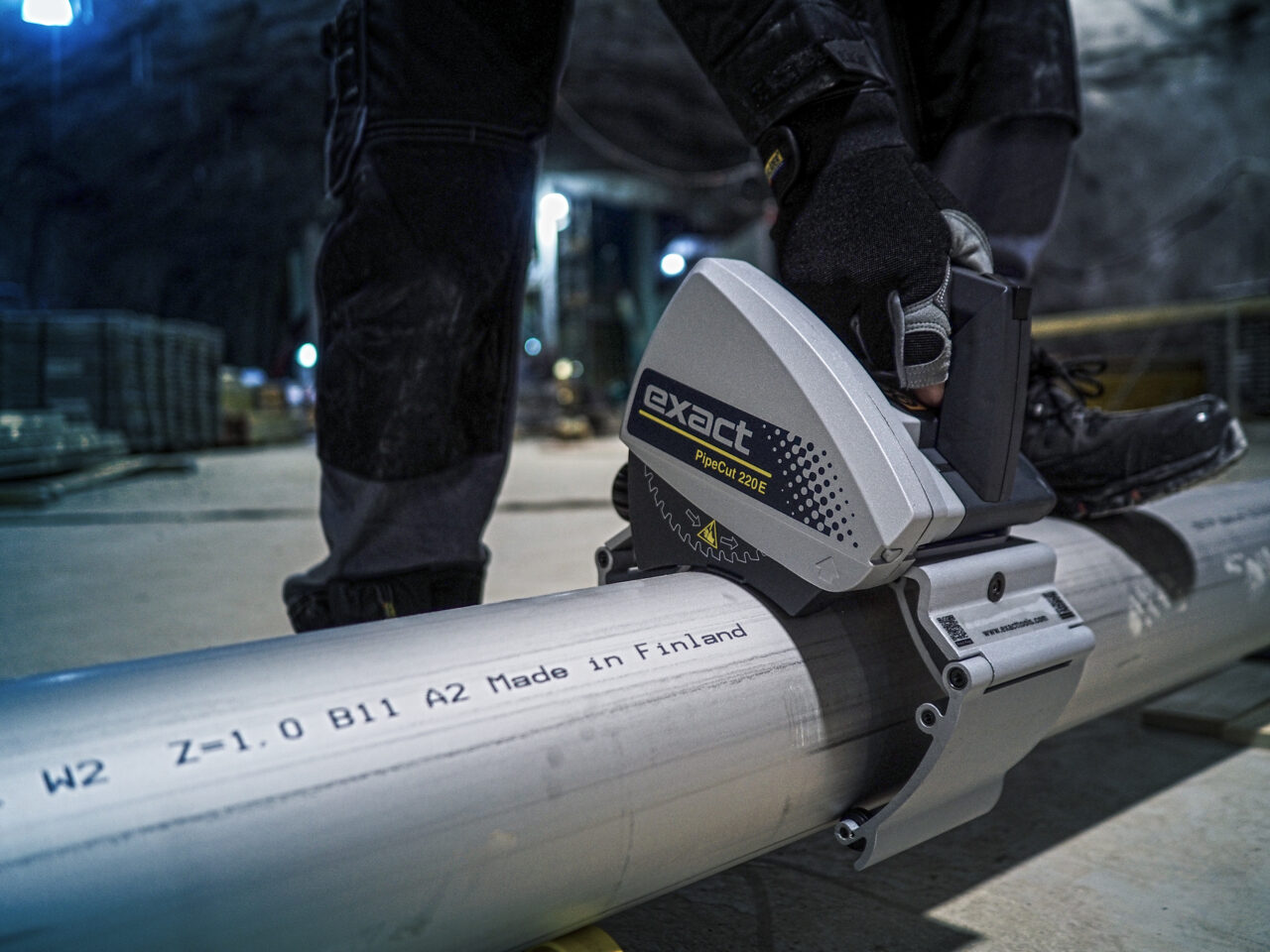
A clean, square cut is the foundation of every good plastic pipe joint. Whether you are cutting PE for a water main, PP for an industrial line or PVC for a drainage run, the quality of the cut decides how smoothly the next step goes. This guide shows you how to cut plastic pipe clean and square with a portable plastic pipe saw, from 50 mm up to 1000 mm outside diameter.
We focus on technique here: marking, supporting, cutting, finishing and staying safe. If you want to compare saws and blades, our plastic pipe cutting range is the place to start.
Matching the Saw to Pipe Diameter and Wall Thickness
Choose the saw by diameter and wall thickness before you pick up a tool. Matching the setup to the pipe is the biggest single factor in cut quality.
| Saw | Pipe OD | Max wall | Materials |
|---|---|---|---|
| PipeCut P400E | 50 to 400 mm | 25 mm (22 mm with Cut & Bevel) | PE, PP, PVC |
| PipeCut P1000 | 60 to 1000 mm | 75 mm with TCT P250 | PP, PE, PVC, HDPE |
Both plastic saws travel around the pipe on solid rubber tire wheels instead of a gripper unit, so the pipe surface is not marked. General-purpose pipe saws also cut plastic: the PipeCut 170E and 220E up to a 14 mm wall, and the PipeCut 360 Pro Series up to 50 mm.
Ventilation duct is a separate case. The PipeCut V800E is built for thin-wall stainless spiral duct, and our article on spiral ventilation duct cutting explains why it needs a different saw.
Pay attention to the pipe construction too. If your pipe has more than one layer, read our guide on cutting multi-layer and composite pipe first.
Checkpoint: before moving on, you should know the pipe material, outside diameter and wall thickness. Every later step depends on them.
PE, PP and PVC: Material Differences That Affect the Cut
Each plastic cuts a little differently, and knowing the differences helps you avoid rough or chipped ends.
- PE and HDPE: tough and flexible. Keep the blade in good condition and the feed steady for a clean face.
- PP: stiffer than PE. A steady, continuous feed gives a smoother face than stopping and starting.
- PVC: harder and more brittle, and more so in cold conditions. Good support near the line and a steady feed at the end of the cut help prevent chipping.
Cold pipe is more brittle, so avoid forcing the saw through the cut in low temperatures.
Blade choice by material is covered in detail in our article on cutting HDPE, PE, PP and PVC pipe. For replacement blades, browse our blades and discs.
Marking a Reliable Square Cutting Line
A square cut starts with a square line. Mark the pipe so the saw has a clear visual reference all the way around, because even a slightly wandering line leads to an angled end.
- Wipe the pipe clean so the marking is easy to see and the saw wheels run on a clean surface.
- Measure the length you need and mark the cut position at one point on the pipe.
- Wrap a straight-edged strip of paper or a flexible marking band around the pipe, lining up the edge with your mark. Check that the edges meet cleanly.
- Draw the line along the edge of the wrap with a fine marker until the line closes.
- Check the line by sighting along the pipe. It should meet itself without a step.
On the PipeCut P1000, use the laser indicator for the cutting point as a second check. Align the laser with your marked line before you begin, and recheck after the saw is seated on the pipe.
Checkpoint: the line should close without a gap or overlap. If it does not, wipe it off and redraw it.
Securing and Supporting the Pipe Before Cutting
Support the pipe so it cannot move, sag or pinch the blade. This step matters most on long, heavy or large-diameter pipe.
- Support on both sides of the cut, close enough that the pipe does not droop when the cut opens up.
- Keep the pipe level so the saw sits square on the surface.
- Do not clamp so tightly that you squeeze the pipe out of round, especially with thin-wall pipe.
- Plan for the offcut. A falling offcut can pinch or tear the last part of the cut, so hold or support it.
The Pipe Support P400 single and double cover pipe from 50 to 1000 mm OD. The PipeCut P400E comes with two P400 Single supports and one P400 Double, with a load capacity of 260 kg with three supports. Browse the full range of pipe supports, or read our guide on how to choose pipe supports for portable pipe cutting to plan your setup.
Checkpoint: push gently on the pipe on both sides of your line. Nothing should shift, rock or sag.
Step-by-Step Cutting for Pipe Up to 400 mm
For pipe from 50 to 400 mm, the PipeCut P400E makes the cut in one controlled pass around the pipe. It handles walls up to 25 mm, or 22 mm when using Cut & Bevel. The saw runs at 1600 to 3500 rpm, with blade speed preselection, soft start, torque control and an automatic fuse.

Set up the saw
- Check that the blade is in good condition and the correct type for the material. The P400E takes 140 or 150 mm blades, with a TCT P150 blade fitted.
- Choose the blade speed for your material using the speed preselection.
- Place the saw on the pipe so the rubber tire wheels sit on the surface.
- Align the blade with your marked line and confirm that the saw sits square to the pipe axis.
Make the cut
- Start the saw. Soft start brings it up to speed smoothly.
- Bring the blade into the wall with a steady, controlled motion.
- Let the saw travel around the pipe at a steady pace. Do not push hard.
- Continue until the cut is complete and the offcut separates cleanly.
- Switch off and let the blade stop completely before lifting the saw away.
The lower blade guard closes instantly when it loses contact with the pipe. If you need a bevel, the P400E cuts and bevels at 15° in one pass with the included Cut & Bevel blade 148, and it can also run cut-only or bevel-only. A battery version, the P400 Battery, also exists. See the PipeCut P400 product page for full specifications.
Checkpoint: the cut end should be flat, with an even surface all the way around and no step where the cut meets itself. Hold a square against the pipe to confirm.
Cutting Large-Diameter Pipe Up to 1000 mm
For large pipe, the PipeCut P1000 handles 60 to 1000 mm outside diameter and walls up to 75 mm with the TCT P250 blade. It is built for PP, PE, PVC and HDPE, with a 1600 W motor and two speeds, 1900 rpm (low) and 2885 rpm (high). The technique is the same as for smaller pipe, but the details matter more because the pipe is heavier and the cut is longer.

Prepare the setup
- Support the pipe on both sides of the cut. The P1000 is supplied with P400 Single and P400 Double supports, with a stated support load capacity of 260 kg.
- Select a blade that suits the wall thickness. The P1000 accepts blades of 140, 148, 150, 165, 180, 190 and 250 mm, with a TCT P190 fitted as standard.
- Preselect the low or high speed for the material.
- Seat the saw on the pipe and use the laser indicator to line up the blade with your marked cutting point.
Cut and monitor
- Start the saw and bring the blade in smoothly.
- Use the traffic light system, which is there to support cutting precision.
- Keep the feed steady all the way around. On thick walls, resist the urge to speed up in the middle of the cut.
- Connect an industrial vacuum to the vacuum port to keep chips under control.
- Support the offcut as it separates, because on large pipe it can be heavy.

If you want a 15° bevel in the same pass, the Cut & Bevel blade 190 is sold separately for the P1000. Whether you need that bevel depends on your joining method, which we cover below. The saw weighs 11.5 kg, so plan the lift when you position it on the pipe. For full details, see the PipeCut P1000 product page.
Checkpoint: the pipe end should be flat and square across the whole diameter. On large pipe, check at several points around the circumference.
Common Cutting Mistakes and How to Fix Them
Most poor cuts trace back to a handful of causes. Spot the problem and correct it on the next cut.
- Angled or stepped cut: usually a misaligned saw or a marking line that did not close. Remark the line, reseat the saw and confirm it is square before starting.
- Rough or smeared cut face: often a worn blade or the wrong blade type for the material. Change the blade and keep the feed steady.
- Chipped exit edge, common on PVC: often poor support or a rushed feed at the end of the cut. Add support near the line and slow down as the cut completes.
- Blade pinching or binding: the pipe is sagging or moving as the cut opens. Reposition the supports and make sure the offcut is held.
- Wavy or uneven end on large pipe: uneven feed pressure or a saw that was not seated flat. Use a lighter, consistent feed and check the saw position before the blade enters.
- Saw bogging down: too much feed pressure for the wall thickness. Ease off and let the saw work at its own pace.
A badly angled end is best recut after marking a fresh line. Having spare blades and useful extras on hand keeps downtime short, and you can find them among our accessories.
Checkpoint: after fixing the cause, make a test cut on a spare piece if you can and confirm the end is square before moving to the real pipe.
Deburring, Beveling and Preparing Pipe Ends
Finish the pipe end before you join it. Even a good cut leaves a sharp edge or fine burrs, and preparing the end properly helps the joint fit and protects the people handling the pipe.
- Inspect the cut end for burrs, swarf and sharp edges, inside and out.
- Remove burrs with a deburring tool or a suitable scraper, taking off only what is needed so you do not change the pipe dimensions.
- Wipe away dust and chips from the end face and bore so nothing contaminates the joint.
- Check that the end is still square, and re-measure the length if you have trimmed the end.
Some joints call for a bevel on the pipe end. Which ones do depends on the joining method and the pipe or fitting manufacturer’s instructions. Our article on cut only or cut and bevel plastic pipe helps you decide based on how the pipe will be joined. If a bevel is needed, the P400E and P1000 produce a 15° bevel in the same pass as the cut when fitted with the Cut & Bevel blade.
Checkpoint: run a gloved hand around the end. It should feel smooth, with no sharp edges or loose material.
Safety, Dust and Offcut Handling
Cutting plastic pipe is safe when you follow good habits. A spinning blade and heavy pipe still deserve respect.
- Wear the right PPE: eye protection, hearing protection, gloves suited to handling pipe and a dust mask where chips or fine dust are present.
- Check the blade guard before every cut. On the P400E and P1000, the lower blade guard closes instantly when it loses contact with the pipe.
- Keep hands clear of the blade and the travel path of the saw.
- Control chips: the PipeCut P1000 has a vacuum port for an industrial vacuum, and blade guards with a vacuum port are available for the PipeCut 220, 280, 360 and 460 Pro Series and the Infinity.
- Handle offcuts safely: support heavy offcuts so they do not drop on feet or pinch the blade, and clear swarf from the work area to prevent slips.
- Disconnect the power before changing blades, and let the blade stop completely first.
Frequently Asked Questions About Cutting Plastic Pipe
What is the best tool for cutting large-diameter PVC pipe?
A portable plastic pipe saw built for large diameters gives a straight, clean result. The PipeCut P1000 cuts PVC, PE, PP and HDPE from 60 to 1000 mm outside diameter, with walls up to 75 mm with the TCT P250 blade. Used with proper supports, it cuts the pipe without marking its surface.
Can plastic pipe be cut and beveled in one pass?
Yes. The PipeCut P400E cuts and bevels at 15° in one pass with its included Cut & Bevel blade 148. The PipeCut P1000 does the same with the Cut & Bevel blade 190, sold separately. Cut-only and bevel-only operations are also possible on the P400E.
Why do plastic pipe saws use rubber wheels instead of a gripper?
The PipeCut P400E and P1000 travel around the pipe on solid rubber tire wheels instead of a gripper unit, so the pipe surface is not marked. That keeps the outside of the pipe clean and undamaged while the blade does the cutting.
How thick a plastic wall can a portable saw cut?
It depends on the saw. The PipeCut 170E and 220E cut plastic up to a 14 mm wall, and the PipeCut 360 Pro Series up to 50 mm. The PipeCut P400E handles up to 25 mm, or 22 mm with Cut & Bevel, and the P1000 cuts up to 75 mm with the TCT P250 blade.
Cutting Plastic Pipe With Exact Tools
Our plastic pipe saws are designed around the steps in this guide: rubber tire wheels that leave the pipe unmarked, a lower blade guard that closes instantly and blades matched to the material.
- PipeCut P400E: for pipe up to 400 mm, with cut and bevel included.
- PipeCut P1000: for pipe up to 1000 mm and walls up to 75 mm.
Not sure which setup suits your pipe? Send us the pipe material, outside diameter and wall thickness through our contact page, and we will help you find the right fit. You can also find a dealer near you. We are happy to help you get every cut clean and square.