

Most pipe cutting problems are not caused by bad luck. They come from a handful of repeatable mistakes in planning, support, tool choice and technique. This guide lists the most common pipe cutting mistakes by stage and tool type, and how to avoid each one. For the full operating sequence with a portable saw, see our step-by-step guide to cutting steel pipe square.
Planning Mistakes
Cutting a pipe that is not confirmed empty
A line can hold pressure, liquid, gas or residue even after the process stops. Isolate, depressurise and drain it, and verify it is empty before cutting; the saws’ operating instructions require it.
Choosing a tool that does not match the pipe
Check the OD range and the maximum wall for the material before you start. For example, the PipeCut 170E and 220E cut steel walls up to 8 mm, and the 360 Pro Series up to 16 or 20 mm depending on the version.
Measuring and Marking Mistakes
- A line that does not close around the pipe: wrap a straight-edged strip around the pipe and draw along it.
- Ignoring the kerf: the blade removes a strip of material, so decide which side of the line it runs on.
- Measuring from the wrong reference: confirm the reference point before marking.
Support Mistakes
A pipe that sags or moves during the cut pinches the blade and pulls the cut out of square. Support the pipe on both sides of the cut, and make sure the cut-off section is held. In the Pro Series instructions, the cut point sits between two supports, with two more under the pipe ends. See how to choose pipe supports.
Blade and Speed Mistakes
- The wrong blade for the material: stainless needs an INOX blade, cast iron and glass fibre need diamond discs, and plastic cuts best with TCT P blades. See our blade selection guide.
- The wrong speed setting: on the PipeCut 170E and 220E, use preset 4 for stainless and acid-resistant steel, 5 for steel and 6 for other materials.
- Running a worn blade: a worn blade produces fine, fragmented chips instead of structured ones. Replace it before the chips turn into fine dust. See our guide to getting more cuts from every pipe saw blade.
Technique Mistakes
- Forcing the feed: pushing harder than the blade can cut leads to crooked lines, overloads and blade wear.
- Starting the motor with the blade touching the pipe: let the saw reach speed first.
- Lifting the saw before the blade stops: switch off and wait.
Hand Tool Mistakes
Tightening a tubing cutter too fast
Forcing the wheel into the wall instead of tightening in small steps can deform the pipe end and leave an inward burr. Tighten gradually as the cutter turns, then remove the burr.
Cutting copper or PVC by eye with a hand saw
Without a guide or a marked line around the pipe, a hand saw wanders. Mark the line and keep the saw square, or use a cutter made for the pipe size. For larger plastic pipe, see our guide to cutting plastic pipe clean and square.
Finishing and Inspection Mistakes
Skipping deburring and inspection sends problems on to the next stage. Check the end for squareness and burrs before joining. Our pipe end inspection checklist gives a routine.
Safety Mistakes
- Skipping eye and hearing protection
- Working without clear access or stable footing
- Using abrasive or thermal methods without assessing sparks and fire risk
See our guide to pipe cutting safety.
Frequently Asked Questions
Why is my pipe cut not square?
The usual causes are poor support, a saw not mounted firmly, a worn blade, the wrong speed or forcing the feed.
What should be done after cutting pipe and before installing it?
Remove burrs and sharp edges, clean the end and check that it is square and at the right length.
Avoid Costly Mistakes With Exact Tools
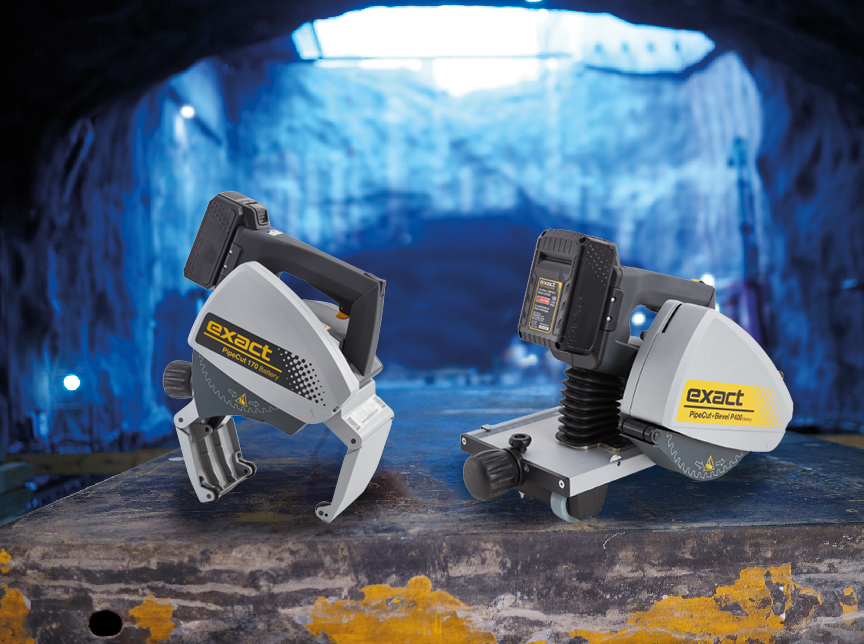
Exact saws mount on the pipe and follow its circumference, which removes the freehand path behind many cutting errors. An Exact saw is usually 8 to 10 times faster than, for example, an angle grinder. Browse our pipe saws, or contact our team with your pipe material, diameter and wall thickness.