

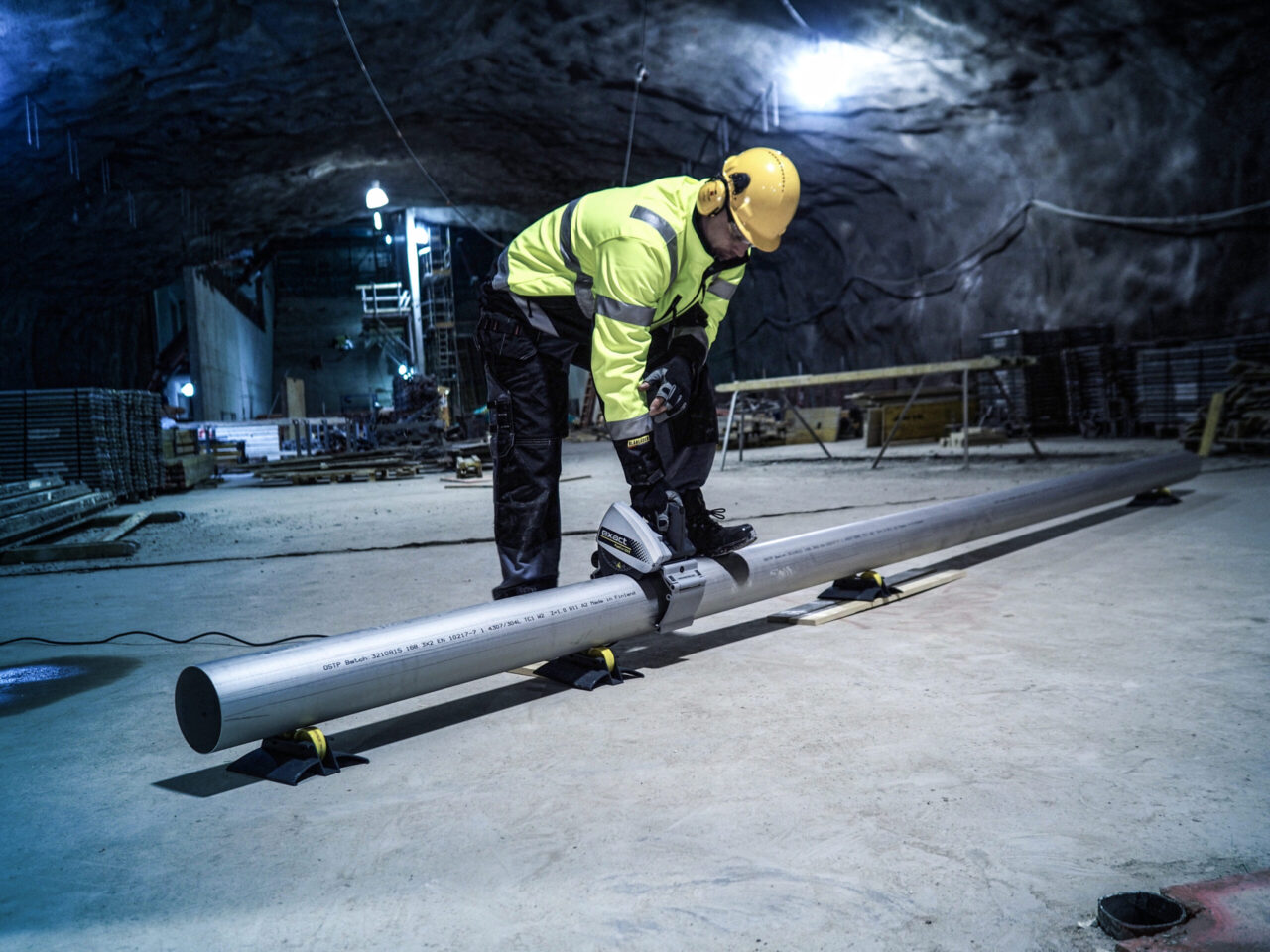
You are looking at two machines that share a name prefix and a blade diameter. That is where the similarity ends. The PipeCut 220E and the PipeCut 220 Pro Series 2.0 sit in different product classes, built for different workloads. Choosing the wrong one costs you either money you did not need to spend or downtime you cannot afford. For a broader view of the full range, see our complete pipe saw model comparison.
This guide puts the PipeCut 220E vs 220 Pro Series decision in plain terms: specs side by side, what the Pro Series adds and why it matters on site, and a duty-cycle framework that tells you which machine fits your actual cutting volume.
Same nominal size, different machine class
The “220” in both names refers to the maximum pipe outer diameter: 220 mm (8.66 in). Beyond that shared ceiling, these are different tools built for different purposes.
The 220E belongs to the Classics line. It is a portable, lightweight pipe saw designed for contractors who cut pipes regularly but not relentlessly. It handles a wide range of materials and delivers clean, square cuts without sparks or flame. If you want to understand how the 220E stacks up against the 170E, see how the 220E stacks up against the 170E within the Classics line.
The 220 Pro Series 2.0 belongs to the Pro Series line. It is engineered for sustained, high-volume cutting where motor endurance, electronic protection, and faster throughput are not optional extras but operational requirements.
Technical specifications side by side
Every figure below comes directly from the respective product pages. Where a spec is not published, the cell is left blank rather than estimated.
- Pipe OD range: 220E: 10 to 220 mm (0.39 to 8.66 in) | Pro Series 2.0: 10 to 220 mm (0.39 to 8.66 in)
- Max wall thickness, steel: 220E: 10 mm (0.39 in) | Pro Series 2.0: 10 mm (0.39 in)
- Max wall thickness, plastics: 220E: 20 mm (0.79 in) | Pro Series 2.0: 20 mm (0.79 in)
- Power: 220E: 1,150 W | Pro Series 2.0: 1,500 W
- No-load speed: 220E: 25 rpm | Pro Series 2.0: 45 rpm
- Blade diameters: 220E: 140 mm (5.51 in) | Pro Series 2.0: 140 mm (5.51 in)
- Weight: 220E: 5.4 kg (11.9 lb) | Pro Series 2.0: 7.5 kg (16.5 lb)
- Electronic unit features: 220E: Soft start | Pro Series 2.0: Soft start, overload protection, speed control
- Standard blade supplied: 220E: TCT 140 | Pro Series 2.0: TCT 140
- Positioned for: 220E: Occasional to regular use | Pro Series 2.0: Daily production use
The power gap, 1,150 W versus 1,500 W, and the no-load speed gap, 25 rpm versus 45 rpm, are the two figures that define the performance difference in practice.
What the PipeCut 220 Pro Series 2.0 adds
Three electronic features separate the Pro Series 2.0 from the 220E. Each one prevents a specific site problem.
- Overload protection: When the motor reaches its thermal or current limit, the machine stops safely rather than stalling mid-cut. A stalled motor mid-cut means a ruined workpiece, a restarted job, and potential motor damage. Overload protection eliminates that failure mode on long shifts.
- Speed control: The machine maintains consistent blade speed under varying load conditions. Without it, blade speed drops as wall thickness increases, which extends cut time and increases blade wear. With it, throughput stays predictable across a full day of mixed pipe sizes.
- Higher no-load speed (45 rpm vs 25 rpm): The faster orbital speed means each cut completes in less time. On a day with forty or more cuts, that difference accumulates into a measurable reduction in total shift time.
The 220E has soft start, which protects the operator from kickback at power-on. That is the right level of electronic management for occasional work. For daily production, you need the full protection set that the Pro Series 2.0 carries.
Cutting performance in practice
Comparative testing has been carried out on both machines using the TCT 140 blade across steel pipe of varying wall thicknesses. The test measures how the two machines perform under the same blade and material conditions, and the results answer a specific question: does the Pro Series 2.0 speed advantage hold in real cutting conditions, or does it narrow once load is applied? If you are also weighing up choosing between the 140 mm blades available for these machines, that guide covers the full options.
For the full methodology and measured results, see the machine comparison test on the 220E and 220 Pro Series. The data there will tell you exactly what the speed difference means in minutes per cut.
Duty cycle: how often do you cut?
The most honest way to frame the PipeCut 220E vs 220 Pro Series decision is not by budget. It is by how many cuts you make in a typical working week.
- Under 10 cuts per week: The 220E is the right machine. You are not running it hard enough to need overload protection or high-cycle speed control. The lighter weight and simpler electronics serve you well at this volume.
- 10 to 40 cuts per week: This is the crossover zone. If your pipe is mostly thin-wall steel or plastic, the 220E handles it. If you regularly cut thick-wall steel or work in a production environment where a stalled motor disrupts a team, consider the Pro Series 2.0.
- 40 or more cuts per week: The 220 Pro Series 2.0 is the pipe saw for daily use at this volume. The speed advantage, overload protection, and motor endurance are not premium features here; they are the minimum spec for the job. Upgrading from 220E to Pro Series at this duty cycle is a straightforward operational decision, not an upgrade for its own sake. If your pipe diameters are pushing toward the upper limit, it is also worth reviewing the next step up in capacity before committing.
Weight, transport, and setup
The 220E weighs 5.4 kg (11.9 lb). The Pro Series 2.0 weighs 7.5 kg (16.5 lb). That 2.1 kg (4.6 lb) difference matters differently depending on your site conditions.
If you carry the machine up ladders, through confined plant rooms, or between multiple floors in a single shift, the lighter 220E reduces fatigue over a long day. Both machines are portable and designed for one-person operation.
If your work is primarily at floor level or on a fixed spool fabrication bench, the extra weight of the Pro Series 2.0 is not a daily burden. Setup time is comparable for both machines. Both use the same 140 mm blade diameter, so if you already stock Cermet blades or TCT blades in that size, your existing blade inventory transfers directly.
Three-year total cost of ownership
The right machine for your duty cycle will cost less over three years than the wrong one, regardless of which direction you choose. Here are the six cost drivers that determine that outcome:
- Blade life: The Pro Series 2.0 has the advantage at high volume. Consistent speed control reduces blade wear per cut, extending the interval between blade changes on busy sites.
- Downtime: The Pro Series 2.0 has the advantage. Overload protection prevents motor damage from sustained heavy cutting, reducing unplanned repair stops that idle a crew.
- Rework from out-of-square cuts: Neither machine has a clear advantage here. Both deliver the same square, burr-free cut that is ready for joining without rework, which is the core benefit of orbital pipe cutting over angle grinding or flame cutting.
- Time per cut: The Pro Series 2.0 has the advantage at any volume above light occasional use. The 45 rpm no-load speed versus 25 rpm translates directly into shorter cut cycles.
- Resale value: Pro Series machines typically retain stronger resale value because the buyer pool for a heavy-duty machine includes production contractors and industrial buyers, not only occasional users.
- Spare parts and service availability: Both machines are supported through the same network. Spare parts and manuals are available for current models, and both machines share the same blade diameter, simplifying parts stocking.
Make your choice with Exact Tools
We build both machines, and we want you to buy the right one for your workload, not the more expensive one. If your cutting volume sits clearly in one of the three duty-cycle bands above, the decision is already made for you.
If your situation is less clear, perhaps a mixed crew, a new contract with an unknown pipe schedule, or a site that combines occasional steel cutting with regular plastic work, we are here to help you work through it. Contact us with your duty cycle and we will give you a direct recommendation. No obligation, no sales process, just a straight answer on which machine fits your work.
You can also explore the full PipeCut 360 Pro Series 2.0 if your pipe diameters regularly exceed 220 mm and you need the same Pro Series protection set at a larger scale.