

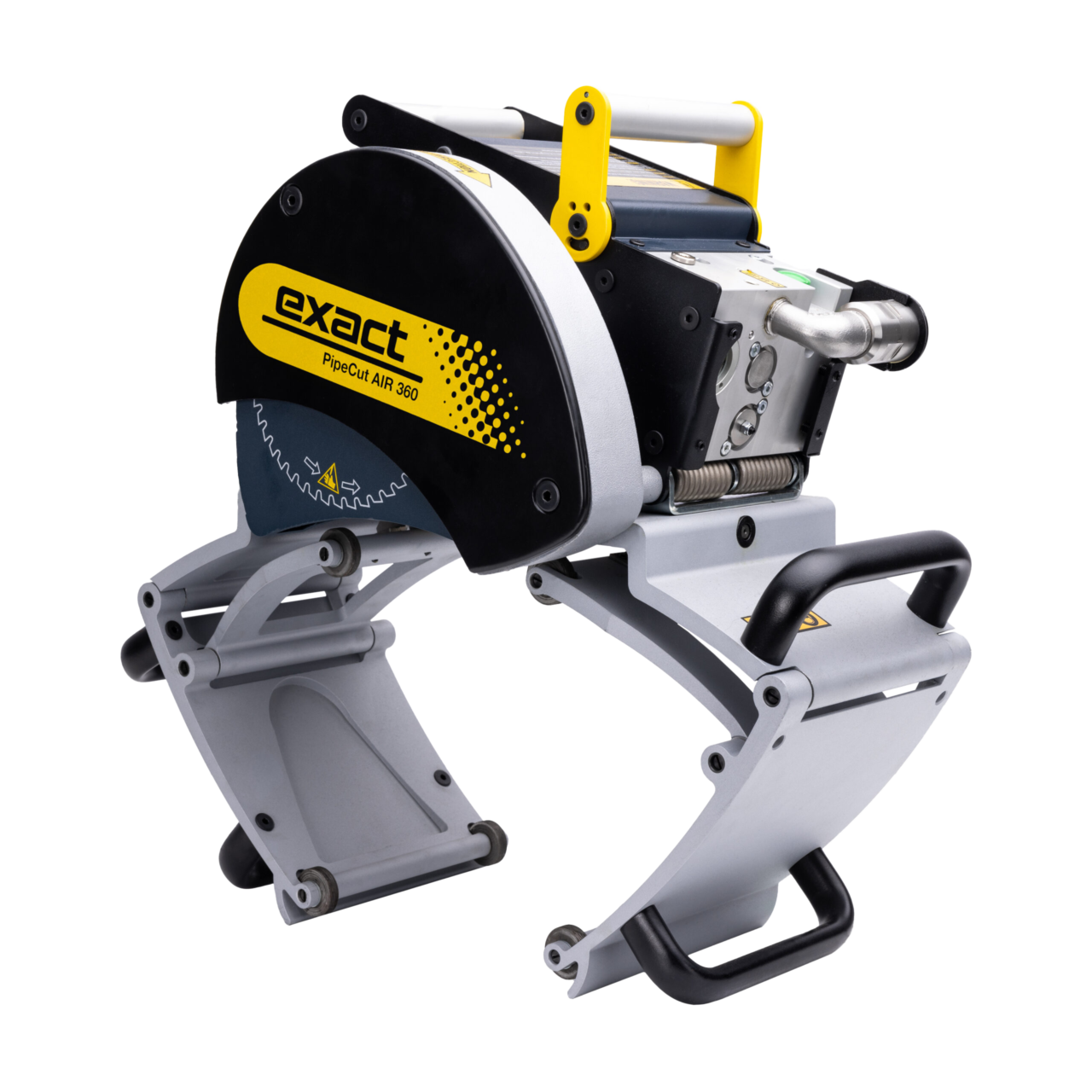
The pipe outside diameter printed on your work order is the only number that matters when choosing between these two machines. Not the wall thickness, not the material, not the pressure rating. If your largest regular pipe fits inside the 360’s capacity, you do not need the 460. If it does not, you do. See our complete pipe saw model comparison if you are still deciding which model range suits your work.
This article walks you through the 360 Pro Series vs 460 Pro Series decision with a concrete spec comparison, a four-step pipe schedule audit, and a clear recommendation at the end.
One number decides the choice, not wall thickness
Both the PipeCut 360 Pro Series 2.0 and the PipeCut 460 Pro Series 2.0 cut steel, stainless steel, copper, aluminum, cast iron, and plastic pipe. Both use the same cold-cutting, spark-free gripper mechanism. Both deliver smooth, straight cuts ready for joining without secondary dressing.
The single specification that separates them is maximum pipe outside diameter. The 360 Pro Series 2.0 tops out at 360 mm (14 in) OD. The 460 Pro Series 2.0, the largest gripper-unit pipe saw in the Pro Series range, extends that ceiling to 460 mm (18 in) OD. Everything else is either identical or very close. If you are considering the step up from the 220, that comparison covers where the capacity increase begins to pay for itself on site.
Wall thickness capacity is a secondary consideration. Both machines handle substantial steel walls, and neither will be the limiting factor for standard schedule pipe within their OD range. Choose by OD first, then verify wall thickness fits.
Side-by-side technical specifications
The table below draws figures directly from the two product pages. Voltage-dependent values are labeled. Cells are left blank where a figure is not published on the product page.
- Pipe OD range: 360 Pro Series 2.0: 10 to 360 mm (3/8 to 14 in) | 460 Pro Series 2.0: 10 to 460 mm (3/8 to 18 in)
- Max wall thickness, steel (110 V): 360 Pro Series 2.0: 16 mm | 460 Pro Series 2.0: 16 mm
- Max wall thickness, steel (220 V): 360 Pro Series 2.0: 20 mm | 460 Pro Series 2.0: 20 mm
- Max wall thickness, plastics: 360 Pro Series 2.0: 50 mm | 460 Pro Series 2.0: 50 mm
- Pipe materials: Both: steel, stainless steel, copper, aluminum, cast iron, plastic, multi-layer
- Blade diameters: 360 Pro Series 2.0: 165 mm and 220 mm | 460 Pro Series 2.0: 165 mm and 220 mm
- Mounting bore: Both: 30 mm
- Cut and Bevel conversion: Both: compatible with Cut and Bevel package for Pro Series and Infinity
The shared blade diameter and mounting bore mean your existing blade inventory transfers between machines. That is a practical advantage if your fleet grows over time.
Pipe supports and why they matter at large diameter
A pipe saw grips the pipe and rotates around it. At large diameters, any movement in the pipe during the cut introduces error into the cut face and creates a safety hazard for the operator. Pipe supports eliminate that movement.
Both machines are compatible with the Pro Series pipe support range. You can use a single pipe support for lighter setups or a double pipe support when the pipe needs steadying from both sides. The supports cover 50 to 460 mm OD, so they scale with whichever machine you choose.
At 460 mm OD, the pipe mass is considerable. Using supports is not optional at that diameter: it is the difference between a controlled, repeatable cut and a dangerous situation. Browse the full pipe support range to match the right configuration to your site conditions.
Handling the 460-class machine on site
A large-diameter pipe saw comparison that ignores logistics is incomplete. The 460 Pro Series 2.0 is heavier than the 360 Pro Series 2.0, and that weight difference matters when you are carrying the machine up a ladder or through a confined plant corridor.
Plan your rigging before the job. On large-bore pipework, the pipe is typically already supported on stands or in a trench. Position the machine, set the supports, and let the gripper mechanism do the work. The cold-cutting process means no hot work permit is needed, which is a significant time saving in process plants and shipyards.
If dust control is a priority on your site, the blade guard with vacuum port fits both the 360 and 460 Pro Series 2.0, keeping the cutting zone clean without additional setup time.
Shared accessories and blades
Blade compatibility across both machines is a real operational advantage. The 165 mm and 220 mm blades with 30 mm mounting bore fit both, so you carry one set of spares for a mixed fleet.
The Cut and Bevel conversion package also fits both machines, turning either saw into a combined cutting and beveling tool for weld-prep work. If your crew does weld-prep regularly, that single accessory removes a separate process step from the workflow.
The pipe schedule test: which machine fits your work
Do not guess your pipe range. Run this four-step audit before you order.
- List every pipe OD you cut in a typical quarter, not just a typical day. A quarterly view captures the occasional large-bore job that a daily snapshot misses.
- Mark the largest OD that appears more than twice. This is your regular maximum. Your machine must handle it without hesitation.
- Mark the largest OD that appears at all, even once. This is your absolute ceiling.
- Apply the rule: buy for step 2, plan a workaround for step 3.
Buying for your regular maximum keeps the machine matched to your daily work. A machine that is oversized for 95 percent of your jobs adds weight and cost without adding value on most days.
For the occasional outsize cut from step 3, a sensible workaround is one of three options: subcontract that specific cut to a specialist, hire a larger machine for the duration of that project, or plan to add a PipeCut Infinity 2.0 to your fleet when that work becomes regular. None of these options require you to over-specify your primary machine today.
When to consider the Infinity series instead
Above 460 mm OD, neither the 360 Pro Series 2.0 nor the 460 Pro Series 2.0 is the right tool. The PipeCut Infinity 2.0 uses a chain mechanism rather than a fixed gripper, which means it has no upper diameter limit. It wraps around the pipe regardless of OD. Understanding when the chain mechanism takes over from a gripper unit helps you plan the right fleet for your diameter range.
The Infinity is also the right choice when the pipe cannot be accessed from all sides, which is common in confined spaces or when the pipe is already installed close to a wall. The chain mechanism adapts to access constraints that a rigid gripper cannot. For a detailed look at the full large diameter setup, including chain configuration and compatible accessories, a dedicated guide covers the process in depth.
If your step 3 pipe from the audit above exceeds 460 mm OD, or if confined-space access is a regular challenge on your sites, the Infinity series is the large-diameter pipe saw to evaluate. A dedicated article covers the Infinity in full depth, including its chain setup and compatible accessories.
Recommendation: which machine is right for you
The 360 Pro Series vs 460 Pro Series decision reduces to one question: does your regular work include pipe above 360 mm OD?
- Choose the 360 Pro Series 2.0 if your regular maximum pipe OD is 360 mm or below. It is lighter, easier to carry on site, and handles the full wall thickness range you need.
- Choose the 460 Pro Series 2.0 if your regular work includes pipe between 360 mm and 460 mm OD. The extra capacity is the only reason to step up, but when you need it, nothing else in the gripper-unit Pro Series range will do the job.
- Consider the PipeCut Infinity 2.0 if your regular maximum exceeds 460 mm OD or if confined-space access rules out a fixed gripper.
Run the four-step pipe schedule audit before you finalize the order. The answer will be in your own job records, not in a product brochure.
Ask Exact Tools for more information
We support contractors, maintenance teams, and plant buyers at every stage, from pre-purchase specification through to on-site troubleshooting. If your pipe schedule spans an awkward range, or if you are building a fleet and need to think through the accessory strategy, we are here to help.
Contact us with your pipe OD range, wall thickness, and material list, and we will confirm the right machine for your application. When you are ready to order, find a distributor near you to move forward.