

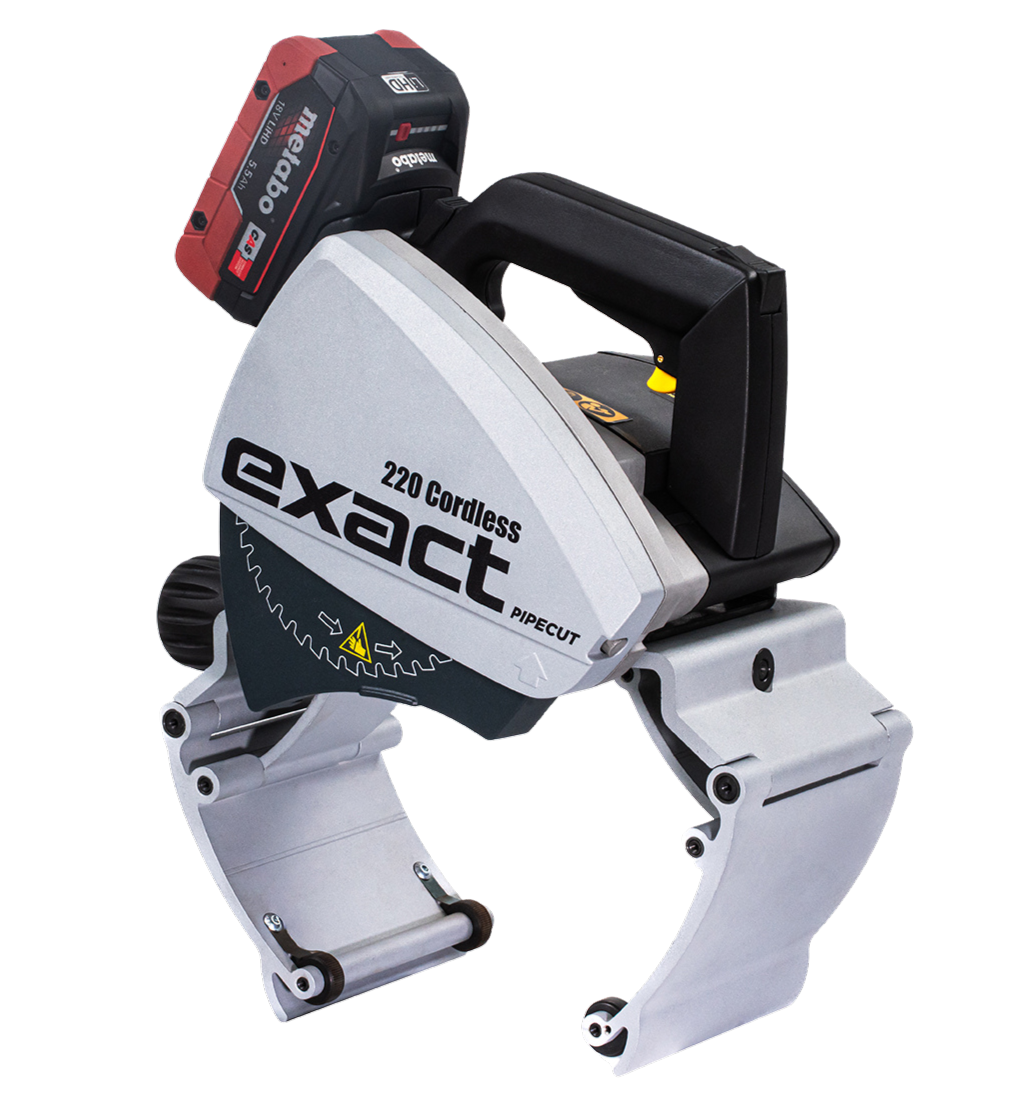
You have two pipes on the job list. One is 150 mm. The other is 320 mm. One machine handles both. The other leaves you reaching for an angle grinder on the larger pipe, and everything that comes with that. If you are still weighing up the full range of options, our complete pipe saw model comparison covers every machine in the lineup.
The choice between the PipeCut 220 Pro Series 2.0 and the PipeCut 360 Pro Series 2.0 is not about features. Both belong to the Pro Series line, share the same design philosophy, and deliver the same cold-cutting, spark-free performance. The decision is almost entirely about capacity, weight, and blade range. Here is how those three factors play out on site.
Capacity difference in practice
The 220 Pro Series vs. 360 Pro Series gap is straightforward: one machine tops out where the other is just getting started. If you are also weighing up the Classics to Pro Series decision, that comparison is worth reading alongside this one.
The 220 Pro Series 2.0 covers the pipe sizes that make up the majority of domestic and light commercial work. The 360 Pro Series 2.0 extends that range to 360 mm OD, a pipe saw up to 360 mm that reaches into district heating mains, process lines, and marine pipework without breaking stride.
If your largest pipe sits comfortably within the 220’s range, buying the 360 adds weight without adding value. If even one pipe on your schedule exceeds that ceiling, the 360 is not optional.
Technical specifications side by side
The table below covers every specification that matters when choosing which Pro Series pipe saw is right for your work.
- Pipe OD range: 220 Pro Series 2.0 covers smaller-diameter pipes up to 220 mm | 360 Pro Series 2.0 covers 75 to 360 mm (3 to 14 inch)
- Max wall steel (220 V): 220 Pro Series 2.0 per product page | 360 Pro Series 2.0 up to 20 mm
- Max wall steel (110 V): 220 Pro Series 2.0 per product page | 360 Pro Series 2.0 up to 16 mm
- Max wall plastics: 220 Pro Series 2.0 per product page | 360 Pro Series 2.0 up to 50 mm
- Pipe materials: Both machines cut steel, stainless steel, copper, aluminum, cast iron, plastic, and multi-layer pipe
- Power: Both available at 220 V and 110 V
- Blade diameters: 220 Pro Series 2.0 takes smaller blade sizes | 360 Pro Series 2.0 takes 140, 165, 180, and 190 mm blades
- Mounting bore: 220 Pro Series 2.0 per product page | 360 Pro Series 2.0 is 62 mm
- Weight: 220 Pro Series 2.0 is lighter | 360 Pro Series 2.0 is 17.7 kg
- Standard blade supplied: 220 Pro Series 2.0 per product page | 360 Pro Series 2.0 ships with a Cermet 165 fitted
- Cut and Bevel conversion available: 220 Pro Series 2.0 – No | 360 Pro Series 2.0 – Yes
Weight versus reach: the honest trade-off
The 360 Pro Series 2.0 weighs 17.7 kg. That number matters more than any spec sheet suggests.
On overhead work or ladder work, every extra kilogram is felt in the shoulders and arms within the first hour. On a long pipe run that requires repeated repositioning, a heavier machine slows the pace and adds fatigue. For single-person handling at the end of a shift, the weight difference between these two machines is real.
If the pipe sizes on your job sit within the 220’s capacity, choose the 220 Pro Series 2.0. It is sufficient, and it is lighter. Recommending the heavier machine where it is not needed does not serve you. Where the 360’s reach is genuinely required, that weight is the cost of the capability, and it is worth it.
For workshop settings where the machine is mounted and repositioned less frequently, the weight of the 360 is far less of a factor. A double pipe support for the 360 and 460 also helps stabilize larger workpieces and reduces handling effort in fixed setups.
Blade range differences between the two models
The 360 Pro Series 2.0 accepts 140, 165, 180, and 190 mm blades, giving you flexibility across pipe materials and wall thicknesses.
For steel and stainless, the Cermet 165 and Cermet 180 are the go-to choices. For general-purpose cutting across mixed materials, the TCT 165 is a reliable option. The wider blade range on the 360 means you can tune the machine to the material rather than accepting a compromise.
Always verify blade compatibility against the machine’s own product page before ordering. Not every blade diameter fits both models.
Cut and Bevel conversion: available on one model only
The Cut and Bevel package for Pro Series and Infinity is available for the 360 Pro Series 2.0 only.
This conversion allows the machine to cut and bevel simultaneously, eliminating a separate weld preparation step. Whether to approach cut and bevel as one operation or two depends on your workflow and the pipe materials involved. The capability applies to cast iron and ductile iron pipe only. If your work involves cast iron mains or ductile iron fittings and you want to remove the beveling step from your workflow, the 360 is the only Pro Series machine that gets you there.
The 220 Pro Series 2.0 does not support this conversion. If Cut and Bevel is a requirement, the choice is already made for you.
Which trade ends up with which machine
- Domestic and light commercial heating – 220 Pro Series 2.0. Pipe sizes in this sector rarely push the 220’s ceiling, and the lighter machine is easier to handle in tight plant rooms and loft spaces.
- Process piping maintenance – 360 Pro Series 2.0. Process lines frequently run to larger diameters, and the 360’s steel wall capacity handles the heavy-wall pipe common in industrial environments.
- District heating – 360 Pro Series 2.0. District heating mains regularly exceed 220 mm OD, and the pipe saw up to 360 mm covers the full range of distribution pipe sizes.
- Marine and offshore fabrication – 360 Pro Series 2.0. Larger structural and service pipe diameters, combined with the need for clean, consistent ends in confined spaces, point firmly to the 360.
- Prefabrication workshop – 360 Pro Series 2.0. A fixed workshop setting offsets the weight penalty, and the wider blade range and Cut and Bevel option add genuine production value.
- General industrial maintenance – depends on the pipe schedule. If the largest pipe on site stays within the 220’s range, choose the 220. If the schedule includes larger-diameter pipe, the 360 handles the full scope without compromise.
What happens if you choose a machine that is too small
The consequence is not dramatic. It is just inconvenient, and it compounds over time.
When a pipe on the job list exceeds the machine’s capacity, you revert to a grinder or flame cutting for that pipe. That means two different cutting methods on a single installation, and two different levels of end quality. The pipes cut with the Pro Series machine arrive clean and square. The pipes cut by hand or grinder need additional preparation before joining.
Across a large installation, that inconsistency adds up in weld preparation time and in the mental overhead of managing two workflows. Buying one size too short to save on upfront cost often costs more in labour before the job is finished. If there is any doubt about where the 360 and 460 line is drawn for very large diameter requirements, that is worth checking before committing.
220 Pro Series vs. 360 Pro Series: which one fits your work
Which Pro Series pipe saw is right for you comes down to one question: what is the largest pipe on your job list?
- If it sits within the 220’s capacity, choose the 220 Pro Series 2.0. It is lighter, easier to handle on site, and fully sufficient for the work.
- If it exceeds that range, or if you need Cut and Bevel capability for cast iron and ductile iron, the 360 Pro Series 2.0 is the right machine.
- If your schedule is mixed and you are not certain, look at the pipe with the largest OD and the thickest wall. That pipe defines the machine you need.
Both machines deliver the same cold-cutting performance, the same spark-free operation, and the same Pro Series build quality. The capacity, weight, and blade range are where they differ, and those differences are what the decision should rest on.
Confirm your choice with our team
Not sure which machine matches your pipe schedule? We are here to help you get it right before you order, not after.
Send us your pipe schedule and we will confirm which Pro Series 2.0 machine covers your full range, whether any accessories are worth adding, and whether the Cut and Bevel option applies to your work. No pressure, just a straight answer from people who know the machines.